curriculum
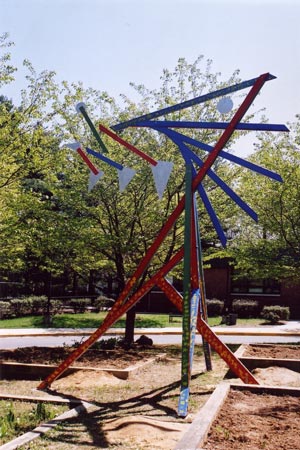
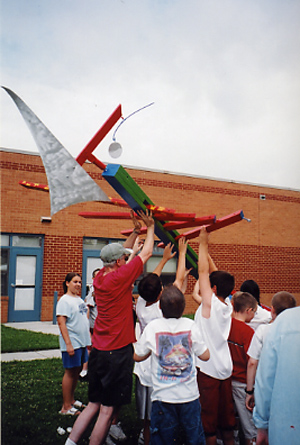
Students will explore a pattern, color, balance, rhythm, symmetry and asymmetry,
positive and negative space, spatial relationships (overlapping, size, proportion
and placement), organic and geometric space - thus increasing their visual
literacy and art vocabulary. Working abstractly allows students
to compare abstract and realistic works of art. Moreover, the residency
provides students with an understanding of site-specific work and the role
The residency and the resulting mobile/sculpture is an ideal
stimulus for writing. During
the residency, students can write descriptively about their experiences in
a journal or report on their experiences for class or school publications. Students
can write poetry inspired by the sculpture and publish a book of class poems
(and illustrations or photos). Students can script and film a video
documentary of the project. Students can name the sculpture.
The residency can inspire students to express through music the movement of
the mobile/sculpture - what is its rhythm, its dynamic, its tempo? Students
can research music or compose their own. Similarly, students of
dance/movement can create a piece inspired by the sculpture's movement.
The principal of balance is a rich springboard
for mathematical analysis--greater than/lesser than, balanced equations,
comparing and contrasting weight and materials. The selection of appropriate material encourages analytical
thinking and the mobile/sculpture's construction requires calculation and physics. The
residency provides students with a hands-on understanding of many abstract
notions. This learning can be extended by having students design and
build their own smaller mobile/sculptures, calculating all weights and measurements.
The sculpture can be based on a major idea central to
the school or to a class's curriculum. Students will have the opportunity to see how an idea
finds abstract expression through a work of art. For example, fourth
graders in Washington DC worked to capture the spirit of immigration